How Tether Co-Founder William Quigley Views Crypto Regulations in Trump’s Second Term

Donald Trump’s re-election has led to expectations of major changes in U.S. cryptocurrency regulations.

Recent executive orders suggest that regulatory changes could soon affect the cryptocurrency industry.

In an interview with PulseWire, William Quigley, co-founder of Tether and WAX, shared his insights into what the next four years under Trump could mean for the industry.

Quigley explained that the administration’s pro-crypto stance, along with key appointments and legislative efforts, could lead to clearer regulations.

He also stressed the role of the private sector in shaping future of cryptocurrency regulations.

Trump’s Second Term and the Future of Crypto Regulation

Trump’s signals of potential changes in crypto regulations contrast sharply with previous administrations’ inconsistent approaches.

Under Trump, there could be an emphasis on installing pro-crypto figures and fostering private sector involvement in virtual assets.

Quigley remarked on the shift, “The Obama administration and the Biden administration in terms of how they thought about crypto, they were wary of it and Congress was not moving forward with any regulation. They didn’t seem to see it as important or terribly problematic either, with the exception of one federal agency, the SEC.”

“The Trump executive order is very positive towards crypto, the statement that Trump wants the U.S. to be a leader in the crypto industry,” Quigley added.

These changes are expected to create a more predictable regulatory environment, reducing uncertainty and supporting market stability.

As the administration moves forward, regulatory decisions will determine how the government interacts with the digital currency sector.

Establishing the Digital Asset Working Group

President Trump’s executive order led to the creation of the President’s Working Group on Digital Asset Markets within the National Economic Council.

This group is responsible for reviewing existing regulations and proposing clearer guidelines for the digital asset sector.

Quigley shared his views on the impact of these developments, “The Trump executive order has created and get an omnibus crypto regulatory framework in the United States. And if that happens, I see all the other major countries in the world moving in a similar direction.”

“To me, [the executive order] seems quite fast because there is so much to consider here, but I think before the Trump term ends, individuals will have ability to use stablecoins much more freely than they do now.,” said Quigley.

The working group is tasked with crafting a federal regulatory framework specifically for digital assets like stablecoins, which will involve detailed considerations on how these assets are issued and operated within the U.S.

The crypto industry awaits the Working Group’s report, due within 180 days, anticipating targeted legislative proposals that could redefine the regulatory environment and enhance market stability.

Quigley Discusses Bank Reluctance

The U.S. banking sector remains cautious about cryptocurrency due to unclear regulatory guidance and the potential for severe penalties.

This hesitancy persists despite more positive remarks from figures like Federal Reserve Chairman Powell, .

William Quigley highlighted the core issues, “Banks are still slow. This might be because they’ve gotten so much crosstalk over the years with what they’re allowed to do and not allowed to do.”

“Any positive messaging from the White House and from the Federal Reserve is very good for us,” Quigley further explained. “But for these institutions, I think they need black and white guidance.”

He also reflected on the broader implications of this reluctance, “In any major financial institution in the United States, there are thousands, maybe tens of thousands of employees who are primarily just compliance oriented people. There’s all these regulatory bodies at the federal level, and some similar ones at the state level, many of whom either give no guidance on crypto, or who give conflicting guidance.”

In traditional banking systems, clarity and compliance remain paramount. The banking sector’s cautious approach to crypto may change in the future, but currently, this wariness serves as a major obstacle to wider acceptance and integration of these technologies.

The Need for Congressional Action in Crypto Regulation

Cryptocurrency regulation in the U.S. suffers from inconsistencies due to multiple agencies managing different aspects without a unified approach.

This fragmented oversight has highlighted the need for a single regulatory body to provide clear and consistent governance.

Trump’s recent executive order is seen as a pivotal step that might prompt Congress to establish a unified regulator, which could help reduce confusion and solidify the U.S.’s position in the global crypto market.

“We can’t have the IRS calling it property, the CFTC saying, no, it’s a commodity, the SEC saying it’s a security, and then the U. S. Treasury forever saying, no, these are currencies, and that existed for years,” said Quigley.

Trump Appoints PayPal Veteran David Sacks as ‘White House AI and Crypto Czar’

President-elect Donald Trump on Thursday night named venture capitalist and ex-PayPal COO David Sacks as his administration’s “AI and crypto czar.”

“In this important role, David will guide policy for the Administration in Artificial Intelligence and Cryptocurrency, two areas critical to the future of American competitiveness,” Trump said in a Truth Social post. “David will focus on making America the clear global leader in both areas.”

Sacks will develop a legal framework to provide the clarity the crypto industry has been seeking, he added.

PayPal Mafia’s David Sacks Gains Spotlight in Trump’s Crypto and AI Agenda

Sacks belongs to Silicon Valley’s “PayPal Mafia,” a group of influential entrepreneurs and ex-PayPal employees like Elon Musk and Peter Thiel. Formed in the early 2000s, this group has shaped the tech industry through successful ventures and investments, leveraging their strong networks and collaboration.

He also gained prominence by founding Yammer, which he sold to Microsoft in 2012 for about $1.2b.

Reports earlier indicated that the incoming Trump administration considered Chris Giancarlo, former CFTC chair, for the “crypto czar” role.

Former Trump Critic Rises as Crypto Advocate and Administration Ally

Sacks’ appointment signals that the second Trump administration is rewarding Silicon Valley figures who supported his campaign. Moreover, it indicates that the administration will push for policies generally supported by crypto entrepreneurs.

Earlier this year, Sacks became a major Trump booster by hosting a fundraiser in San Francisco for the then-Republican nominee. At this event, tickets went for $50,000 each, with a $300,000 tier that offered perks like a photo with Trump.

This represented a stark change for Sacks, who had sharply criticized Trump following the Jan. 6, 2021, Capitol riot. Shortly after, on an episode of his All-In podcast, Sacks stated that Trump was “clearly” responsible for those events and had disqualified himself from national candidacy.

In recent years, Sacks has gained prominence as the host of the All-In podcast, co-hosting with investors Chamath Palihapitiya, Jason Calacanis and David Friedberg. In his post, Trump described it as the “top podcast in Tech,” where they discuss economic, political and social issues.

This week, Trump named Paul Atkins, a seasoned financial regulator and crypto advocate, to head the SEC. Explaining his choice, Trump called Atkins a “proven leader for commonsense regulations” and praised his stance against overregulating markets.

Elon Musk Grok AI Predicts Explosive Bitcoin Price by The End of 2026

There is a specific phrase in this prediction worth sitting with for a second, classic post-halving correction phase. Elon Musk’s Grok AI is not predicts the current chart as weakness or trend failure.

It is describing it as a known stage in a known cycle, one that has historically resolved into the most explosive part of the entire bull market. At $64,000, that framing is the difference between fear and patience, and Grok is firmly on the side of patience.

The base case is $150,000 to $200,000 by December 2026, with a strong bull scenario stretching past $250,000 if ETF inflows accelerate and macro conditions turn decisively risk-on.

Source: Grok AI Bitcoin Price Prediction

That is a 2.3x to over 3.9x move from here, built on the same drivers that have shown up across nearly every major prediction in this series.

Surging institutional adoption through spot ETFs, growing sovereign and corporate treasury accumulation, improving global liquidity from potential rate cuts, and the hardest variable of all, a fixed 21 million coin supply that gets more scarce by the day.

What makes Grok’s case distinct is the historical anchor. Cycle patterns point to the parabolic peak landing 12 to 18 months after the April 2024 halving, which places the ignition point squarely in Q3 to Q4 2026, right where the prediction sets its target window.

The bear case is treated as a detour rather than a derailment. Extended macro headwinds or delayed liquidity could drag prices toward $45,000 to $55,000 support before rebounding, potentially capping the cycle top at $100,000 to $120,000 instead of six figures beyond that.

Bitcoin (BTC)
24h7d30d1yAll time

Even Grok’s pessimistic scenario keeps Bitcoin meaningfully higher than today, which tells you how asymmetric this setup looks from where price currently sits.

Bitcoin Price Prediction: The Floor That Keeps Refusing To Break

BTC is at $64,042 today, sitting almost exactly where it traded back in February after the post-ATH selloff first hit. That repetition matters.

This is now the third distinct test of the $60,000 to $64,000 zone since the all-time high near $128,000 last October, and each prior test produced a recovery rather than a breakdown.

Markets that keep finding buyers at the same level over many months are telling you something about where real demand sits, and this zone has earned that credibility through repetition rather than a single bounce.

Source: BTCUSD / Tradingview

The overhead picture is where the real test lives. Every recovery attempt since the October peak has stalled somewhere between $80,000 and $96,000, a wide band of resistance built from trapped buyers at multiple failed breakouts.

For Grok’s six figure thesis to gain real traction on the chart, Bitcoin needs to clear that entire zone decisively rather than just poke through it temporarily, the way it did briefly in October before reversing hard.

The RSI sits at 37.63 with the signal line at 31.33, a gap of just over 6 points, modest compared to some of the sharper divergences seen elsewhere in this series but still meaningfully positive.

Momentum dipped into the high 20s during the June low and has since climbed back above its average without yet reaching neutral, which is consistent with a market still digesting the correction phase Grok describes rather than one already accelerating into a new leg.

That is actually the more honest signal here. The chart is not yet shouting bull market. It is quietly suggesting the bleeding from this correction has slowed, which is precisely the stage that should come before the launch Grok is calling for in the back half of the year.

Discover: The Best Token Presales

You Might Like What Grok AI Predicts About LiquidChain

The rotation is happening now. Most people will only spot it in hindsight.

Large-cap crypto isn’t failing. It’s capped. Bitcoin, Ethereum, and XRP have pressed against the same resistance bands for weeks, and the macro tailwinds keep getting pushed back a quarter. Holding assets whose upside depends on someone else’s catalyst isn’t a strategy. It’s waiting.

Capital that has survived enough cycles moves before the destination becomes obvious, not after.

Google Gemini AI models predicts a robust Bitcoin recovery to $80,000 by July, viewing $61,073 low and oversold RSI as profit-taking bottom.

Early-stage infrastructure runs on different math. A market cap small enough turns a modest rotation into a sharp price move. The asymmetry exists because the market hasn’t priced in what’s being built yet, and the gap between current valuation and actual worth is where the return comes from.

Multi-chain fragmentation drains real money out of DeFi every day. Bitcoin, Ethereum, and Solana operate as isolated liquidity systems with no native connection between them. Anyone moving value across ecosystems pays for that isolation directly, in fees, slippage, and failed transactions.

LiquidChain folds all three networks into a single execution layer. One deployment reaches the full ecosystem. No tax on crossing between chains.

The market hasn’t found this yet. That’s the point.

The presale sits at $0.01454, with just over $840,000 raised. Ground floor isn’t marketing language here; it’s a literal description of where the project sits in its lifecycle.

Execution is unproven. Adoption is unknown. Those risks are real and worth stating plainly. Established assets offer a smoother climb toward a ceiling the market can already see. This is an earlier seat at a table nobody has built yet.

Explore the LiquidChain Presale

Meme Coin Capital Rotation: Maxi Doge Presale Hits $4.8M as SPX6900 Consolidates After Exchange Listings

The cryptocurrency market is experiencing a notable rotation of capital as established meme assets such as SPX6900 undergo consolidation. Following a significant rally driven by major Asian exchange listings, profits are flowing into early-stage presales. At the forefront of this shift is Maxi Doge (MAXI), which has recently surpassed the $4.8 million milestone and is rapidly approaching its $5 million target.

SPX6900 Consolidation Triggers Capital Reallocation


On Thursday, June 18, 2026, market attention focused on SPX6900 (SPX) as it completed an 87% rally from June 5, reaching a peak of $0.497. This upward momentum was catalyzed by listings on Upbit and Bithumb, South Korea’s dominant cryptocurrency exchanges.

While industry analysts, including Murad Mahmudov, highlighted these listings as critical milestones for global retail adoption, the achievement also triggered expected profit-taking. Following the peak, SPX experienced an 18% correction, stabilizing around the $0.40 mark.

This cooling-off period has historically redirected liquidity into early-stage projects. Investors are increasingly seeking pre-market entry points that offer structured incentives before public exchange debuts occur.

Maxi Doge Presale Structure and Yield Utility


Operating in its initial funding phase, the Maxi Doge (MAXI) presale allows participants to acquire tokens at a fixed rate of $0.0002824. Unlike purely speculative meme assets, the project integrates a decentralized staking mechanism designed to incentivize long-term holding.

Participants can lock their tokens to secure an estimated 65% Annual Percentage Yield (APY). This yield structure aims to mitigate early volatility by rewarding community members with consistent daily distributions, shifting the asset’s value proposition toward active utility.

By pairing recognizable branding with a functional staking protocol, the project aims to establish a sustainable liquidity foundation prior to its public listing.

Step-by-Step Guide to the MAXI Presale


For market participants looking to allocate capital to the presale, the process involves several standardized steps:

  1. Set Up a Compatible Wallet: Secure a Web3-compatible wallet. The Best Wallet application is frequently utilized for its mobile-optimized interface, available on the and .
  2. Connect to the Platform: Navigate to the official Maxi Doge presale website and link the digital wallet.
  3. Select Payment Method: Transactions can be executed using several major cryptocurrencies, including ETH, BNB, USDT, and USDC. Alternatively, direct bank card purchases are supported.
  4. Initiate Staking: After acquiring MAXI tokens, users can immediately allocate them to the staking pool to begin accumulating the 65% APY rewards.

To follow development milestones and community announcements, users can and .

Visit Maxi Doge Token.

Ethereum News: ETH Developers Hit Near Record Highs Even as ETH Dumped Below $1,750, Is the Network Stronger Than the Price Suggests?

Ethereum News: ETH price is sitting near $1,750, down roughly 1.4% in the last 24 hours, and the bears are clearly running the short-term narrative.

But strip out the price action, and something more durable is happening underneath. Developer growth tells a story that the chart currently refuses to.

New developers building on Ethereum have climbed from approximately 30,000 in 2016 to nearly 140,000 in 2025, and crucially, that growth did not pause during the brutal drawdowns.

When ETH dropped 82% in 2018, roughly 77,000 new developers joined the network anyway. When ETH shed 68% in 2022, new developer additions hit approximately 139,000, one of the strongest cohort years on record.

Source:

Even now, with ETH down around 11% year-to-date, developer intake remains close to that same 140K ceiling. Block production has also stabilized near the 7,000-blocks-per-day range since approximately 2023, regardless of where spot price traded.

The gap between price performance and network health is widening. That divergence is worth taking seriously before the next macro catalyst forces a re-rating. Upcoming protocol decisions and FOMC positioning will likely be the near-term triggers that determine which way that gap closes.

Ethereum News: Can ETH Price Reclaim $2,000 or Is a Drop to $1,500 the More Likely Path?

The technical setup is uncomfortable. ETH broke below a key demand zone, and Yahoo Finance’s technical analysis marks $1,700 as the line in the sand, with the path to $1,400 largely unobstructed if that level fails.

Overhead resistance compounds the problem. The 50-day EMA sits near $2,194 and the 200-day EMA near $2,510, and both have capped every recent bounce attempt.

Source: ETHUSD / Tradingview

If $1,700 holds as weekly support, macro sentiment stabilizes after FOMC, and ETH reclaims $2,000 within two to three weeks on renewed risk appetite.

However, if $1,700 fails on a daily close, derivatives pressure accelerates the slide toward $1,400-$1,500. Liquidation cascades, not fundamentals, have been the primary driver of recent drawdowns, the flush could move fast rather than gradual.

Standard Chartered and other institutional desks still hold constructive multi-year ETH price targets, which keeps the capitulation thesis incomplete until on-chain accumulation data turns materially bearish.

LiquidChain Could Replace Ethereum For Smart Traders In The Future and Here is Why

When Ethereum bleeds, it tends to flush speculative capital out of the broader ecosystem, and that capital often rotates into early-stage infrastructure plays with asymmetric upside profiles that large-cap ETH can no longer offer at current market cap.

The question is where that rotation lands. Whale accumulation patterns during ETH weakness suggest sophisticated money is positioning in infrastructure, not exiting crypto entirely.

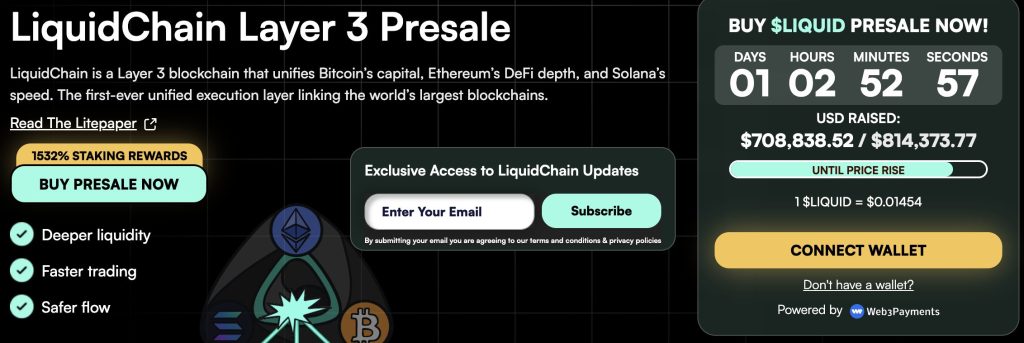
LiquidChain (LIQUID) is an L3 infrastructure project positioning itself as a cross-chain liquidity layer that fuses Bitcoin, Ethereum, and Solana liquidity into a single execution environment.

The core proposition, deploy once, access all three ecosystems, directly addresses the fragmentation problem that costs Ethereum developers time and TVL every cycle.

Key architecture features include a Unified Liquidity Layer, Single-Step Execution, Verifiable Settlement, and a Deploy-Once Architecture designed to reduce cross-chain overhead.

The presale is currently priced at $0.01471 per $LIQUID with $852,080.07 raised to date. As with any early-stage presale, liquidity and execution risk are real — this is not a liquid position and vesting schedules matter.

That said, for traders who want infrastructure exposure without riding ETH’s current technical uncertainty, Visit LiquidChain’s full presale terms here.

Bitcoin and Dogecoin Remain Elon Musk Favorite Crypto: Best Crypto to Buy Now?

Elon Musk just crossed $1.3 trillion in net worth, and the world’s first trillionaire still holds Bitcoin and Dogecoin. Dude is orange-pilled, and this fact alone is moving sentiment across both markets this week.

Analyst Ali Martinez flagged the milestone on X, pairing a Musk sketch with the Bitcoin logo and the caption “Let that sink in.” As of now, BTC is consolidating above $64,000 while DOGE trades at $0.084, both in structurally corrective but not broken technical positions.

The institutional angle carries weight here. SpaceX holds 18,712 BTC valued at $1.19 billion at current prices, while Tesla carries 11,509 BTC worth over $734 million on its balance sheet, making them the only two top-10 market-cap companies with crypto reserves.

Musk’s personal holdings remain publicly ambiguous; he disclosed just 0.25 BTC back in 2020 and has said nothing definitive since. Meanwhile, the Fed held rates unchanged this week, and futures markets assign near-zero probability to a July cut, a macro backdrop that keeps risk appetite measured but hasn’t broken crypto’s bid.

Discover: The Best Token Presales

Will Bitcoin and Dogecoin Break Higher?

Bitcoin (BTC)
24h7d30d1yAll time

Bitcoin’s structure reads as post-breakout consolidation. Price is holding above the prior cycle’s breakout zone, which is historically where altseason rotation capital stages before deploying into meme coins and mid-caps.

The key macro support level to watch is the $60,000 area; a Wyckoff-style retest of that zone would represent the primary bearish invalidation. On the upside, a clean break above $70,000 is the trigger most analysts are watching for continuation toward the $80K range cited in end-of-cycle models.

Dogecoin (DOGE)
24h7d30d1yAll time

Dogecoin setup is tighter and arguably more interesting technically. Our research has flagged that DOGE is now mirroring BTC’s price action more closely than it tracks Musk tweets, which changes the trade calculus.

The current price near $0.085 sits at a structural accumulation zone, with analysts identifying a developing double-bottom pattern.

Discover: The Best Crypto to Diversify Your Portfolio

Maxi Doge: The New DOGE

DOGE at $0.085 offers a recognizable brand and Musk association, but also a $13 billion market cap floor and a price that needs to move several multiples to deliver the kind of return early-cycle DOGE holders captured. That math is what sends traders hunting for earlier-stage exposure when meme coin momentum picks up. The asymmetry shrinks considerably at this size.

Maxi Doge ($MAXI) is an ERC-20 meme token built around a high-conviction trading community identity, the “240-lb canine juggernaut” built for 1000x leverage mentality, with the tagline Never skip leg-day, never skip a pump.

The presale has raised $4.8 million at a current price of $0.0002824, with a huge 65% APY available to holders. Features include holder-only trading competitions with leaderboard rewards and a Maxi Fund treasury earmarked for liquidity and partnerships.

The meme-first marketing mirrors exactly what drove early DOGE traction: community-led, identity-driven, and spreadable.

Research Maxi Doge and size accordingly.

Bitcoin Price Prediction: The Dollar Index, Hawkish FOMC, and Other Threats

Bitcoin is trading around $64,000, nursing a modest 24-hour decline as macro conditions tighten, and has historically punished price prediction hard. The catalyst is familiar, but the intensity is fresh: Kevin Warsh, the chair of the Federal Reserve, has rattled markets with a hawkish posture.

To make things even worse, the U.S. Dollar Index has also surged more than 0.6% on Wednesday, breaking above the 100 resistance, with analysts targeting 106.20 as the next technical objective. The move came after fed funds futures repriced a 35% probability of a quarter-point rate hike by September, up sharply from 12% just one week prior.

Short-dated Treasury yields jumped 10 basis points on the session, too. The S&P 500 dropped 0.4%, and BTC slipped below $67,000 in the immediate reaction, only to subsequently consolidate lower into the current range.

Discover: The Best Crypto to Diversify Your Portfolio

Bitcoin Price Prediction: What’s Next?

At $64,000, BTC sits in an uncomfortable middle zone. In the 48-hour setup, we flag overhead resistance concentrated in the mid-$60,000s, the same band that has repeatedly rejected upside attempts. Moving averages are flattening, momentum indicators are cooling, and ETF inflows have moderated.

Support in $62,000 is the line that matters most right now. A close below that area opens a path to deeper pullbacks that technical setups alone won’t prevent, and macro headwinds would accelerate the move.

Bitcoin (BTC)
24h7d30d1yAll time

The bulls would want DXY to stall, inflation data to print soft, and so BTC can reclaim mid-$60,000s resistance on volume, setting up a retest of $67,000.

However, if DXY drives above 106 and cracks BTC through the low-$60,000 support, it would open room toward the high $58,000.

Funding rates and open interest have already moderated, suggesting speculative leverage has been rinsed. That reduces the risk of a cascade, but it also means there’s less fuel for a sharp recovery bounce. The path of least resistance stays sideways-to-lower until macro clarity arrives.

Discover: The Best Token Presales

Bitcoin Hyper Targets Early-Mover Upside as Bitcoin Battles in Support Zone

When spot BTC is range-bound and macro headwinds are real, rotation capital tends to search for asymmetric early-stage exposure. Projects where the upside math is structurally different from buying an asset already deep into its price discovery cycle.

The dynamic above is exactly what makes the current environment worth scanning for infrastructure-layer presales with genuine technical differentiation.

Bitcoin Hyper ($HYPER) is positioned as the first Bitcoin Layer 2 with Solana Virtual Machine (SVM) integration, a combination that targets Bitcoin’s core limitations: slow throughput, high fees, and the absence of programmable smart contracts.

The project claims sub-Solana latency on its Layer 2 processing, with a Decentralized Canonical Bridge for native BTC transfers that preserves Bitcoin’s base-layer security.

The presale is currently priced at $0.0136, with $32 million raised. They are meaningful tractions for a pre-launch infrastructure play. Staking is also live with a high APY for early participants.

Those who want to assess the fundamentals further can research Bitcoin Hyper here before the current stage closes.

Bitcoin News: Zimbabwe Just Regulated Crypto, But Could a Bitcoin Treasury Save Its Economy?

In the most recent Bitcoin News, Zimbabwe’s Financial Intelligence Unit issued a binding mandate on June 16, 2026 requiring all virtual asset service providers to register under Statutory Instrument 99 of 2026, the country’s first dedicated crypto regulatory framework, effective immediately, with criminal liability for non-compliance.

The framework formalizes what has been an eight-year grey market built largely on hyperinflation-driven demand for dollar-denominated alternatives to a succession of collapsing local currencies.

Source:

The regulatory event is straightforward. The question it reopens is not: if Zimbabwe can build the institutional scaffolding to supervise crypto, is there a coherent case for the state itself to hold a Bitcoin reserve as a monetary anchor? The answer cuts both ways, and the arithmetic deserves a serious look.

Discover: The Best Crypto to Diversify Your Portfolio

Bitcoin News: SI 99 of 2026: What the FIU Mandate Actually Covers

The legal chain is worth anchoring precisely. The Finance Act No. 7 of 2025, passed in December 2025, amended Section 2 of Zimbabwe’s Money Laundering and Proceeds of Crime Act to incorporate VASPs into the statutory definition of a financial institution.

Acting under those expanded powers, the Zimbabwean Minister of Finance gazetted the Money Laundering and Proceeds of Crime (Virtual Asset Service Providers Registration) Regulations on June 10, 2026, codified as Statutory Instrument 99, and the FIU issued its public enforcement mandate six days later.

The scope is broad and technology-neutral. Any entity exchanging cryptocurrencies for fiat, providing custody services, or facilitating crypto-related financial transactions must register. Notably, decentralization is not an exemption: if an operator can adjust smart contracts, route funds, or set transaction fees, the FIU considers them a VASP.

Registration carries a US$500 initial fee and US$400 annual renewals, requires a locally incorporated entity, director background checks, KYC implementation, transaction monitoring, and compliance with the FATF Travel Rule.

The FIU was explicit about what registration does not provide. “Registration with the FIU for AML/CFT purposes does not, in itself, constitute authorization to carry on business in Zimbabwe,” the public notice stated.

VASPs still need separate operational approvals from the Reserve Bank of Zimbabwe or the Securities and Exchange Commission of Zimbabwe, depending on their business model. This two-layer structure – crypto regulation for AML monitoring on one track, commercial licensing on another, is standard FATF architecture, and Zimbabwe is explicitly aligning itself with those international standards.

The historical context makes the policy shift sharper. In 2018, the RBZ issued Circular No. 2/2018 ordering all banks to cease servicing crypto exchanges and exit existing relationships within 60 days.

Local exchange Golix challenged the ban in court and obtained a provisional High Court order lifting it specifically against Golix, but broader regulatory uncertainty persisted for years.

SI 99 is effectively the formal end of that ambiguity, a supervised integration model replacing blanket exclusion, driven by the recognition that hyperinflation and chronic currency instability had already pushed citizens into crypto regardless of official policy.

Discover: The Best Token Presales

XRP Price Prediction: Breakout Attempt Rejected at Resistance — What’s Next?

XRP price is trading under $1.20 after sellers crushed another breakout prediction at the $1.25 descending trendline resistance. The rejection came on elevated volume, spot markets logged net outflows, and the token is now coiling inside a compression pattern that is running out of room. Something has to give.

The latest rejection was accompanied by a telling split: spot market participants pulled back while derivatives traders added longs. Real money leaving, speculative money staying, and it is not a healthy accumulation signal.

XRP has now tested and failed at the same descending trendline multiple times for months, forming what analysts describe as a year-long symmetrical triangle approaching its apex.

With the pattern tightening and macro crypto sentiment still unresolved, the next directional move will be sharp.

Discover: The Best Crypto to Diversify Your Portfolio

XRP Price Prediction: When Will The Triangle Break?

Current price sits at $1.19, wedged between trendline resistance at $1.25 and the first meaningful support shelf at $1.10. The gap between those two levels is thin, which means XRP is effectively at a decision point right now.

Volume context also matters here. The spot outflows suggest the most recent rally was driven more by derivatives positioning than genuine accumulation. That is the kind of setup that produces sharp reversals once longs get squeezed.

Longer-term charts still show XRP trading beneath major moving averages despite the rebound from early lows, a structural headwind that confirms the path of least resistance remains sideways-to-lower absent a catalyst.

Xrp (XRP)
24h7d30d1yAll time

A daily close above $1.25 on strong spot volume flips the trendline from resistance to support and opens a run toward $1.30. Recent ETF inflows and growing institutional participation, the same tailwinds that drove last week’s move above $1.25, could provide that catalyst if macro conditions cooperate.

XRP could also continue grinding inside the triangle, testing $1,25, with price oscillating between $1.15 and $1.25 until the apex forces resolution. Tedious, but probable given the current spot demand picture.

Discover: The Best Token Presales

LiquidChain Targets Early-Mover Positioning as XRP Stalls at Resistance

XRP at under $1.20 with a capped upside of 7% to resistance is not the asymmetric setup most active traders are hunting right now. The triangle will resolve, it always does, but waiting at current prices means sitting inside a binary outcome with limited room to add before the move.

The above calculus is pushing part of the market toward early-stage infrastructure plays where entry price still creates meaningful upside compression.

LiquidChain ($LIQUID) is a Layer 3 infrastructure project building what it describes as a unified cross-chain liquidity layer, fusing Bitcoin, Ethereum, and Solana liquidity into a single execution environment.

The architecture is built around four pillars: Unified Liquidity Layer, Single-Step Execution, Verifiable Settlement, and a Deploy-Once system that lets developers access all three ecosystems without redeployment overhead. As cross-chain fragmentation remains one of the most persistent structural problems in DeFi, the category has genuine demand.

The presale is currently priced at $0.014 with $850K raised to date.

Traders doing their own research can review the LiquidChain presale details here.

Solana Scores Crypto’s First Moody’s Credit Ratings Onchain

Breaking Solana news: Moody’s Ratings deployed its credit ratings infrastructure on Solana mainnet on June 17, 2026, through a partnership with AlphaLedger, making Solana the first major public, permissionless blockchain to carry live Moody’s credit ratings in machine-readable form.

The integration embeds ratings directly into the token metadata of tokenized bonds and other fixed income securities, meaning the credit signal travels with the asset on-chain rather than sitting behind a proprietary terminal.

For institutional participants building on Solana’s RWA stack, this closes one of the most obvious gaps in tokenized debt markets: access to standardized, independent credit analysis at the protocol level.

The distinction from Moody’s earlier Canton Network rollout matters structurally. Canton is a permissioned, institutional-grade blockchain with a defined set of vetted participants.

Solana is open infrastructure, any wallet, trading venue, or DeFi protocol can now query Moody’s credit data directly from on-chain token metadata without credentialing through a closed network. That shift from permissioned to permissionless delivery is what makes this announcement materially different from what Moody’s has done before.

Discover: The Best Crypto to Diversify Your Portfolio

Solana News: How the Token Integration Engine Actually Works on Solana

Moody’s Token Integration Engine, known as TIE, is designed as network-agnostic infrastructure: ratings are assigned off-chain using Moody’s standard methodology, then pushed on-chain via API through

AlphaLedger’s platform, where they are embedded into the token metadata of the underlying security. When a rating changes, upgrade or downgrade, that update propagates on-chain automatically, so any application consuming the data gets a live credit signal rather than a static snapshot.

The system was first validated in a June 2025 proof-of-concept on Solana’s devnet, where AlphaLedger simulated a municipal bond issuance, Moody’s ran a full credit assessment, and the resulting rating was written into the token’s metadata and made queryable by smart contracts.

The mainnet rollout scales that proof-of-concept to production, with early focus on U.S. municipal bonds and other fixed income instruments.

Manish Dutta, Chief Executive Officer of AlphaLedger, said the integration allows tokenized markets to use the same credit information that investors rely on in traditional fixed-income markets. That framing is precise: the goal is not to create a parallel ratings system but to make the existing one programmatically accessible on a public chain.

Rajeev Bamra, Head of Digital Economy Strategy at Moody’s Ratings, said investors increasingly need access to independent credit analysis in on-chain environments.

The specific problem TIE targets is automated risk management, giving DeFi protocols and digital asset platforms a trusted, machine-readable credit input they can use for collateral decisions, margin policies, and investment eligibility filters without routing through proprietary data feeds.

That use case has been largely theoretical in tokenized bond markets until now.

Discover: The Best Token Presales

Solana’s Institutional RWA Position: What This Integration Confirms

The Moody’s integration arrives as Solana’s institutional real-world assets pipeline has deepened considerably. Western Union launched a U.S. dollar stablecoin on the network targeting lower-cost remittances.

Blockchain developer R3, whose Corda network counts HSBC, Bank of America, the Bank of Italy, and the Monetary Authority of Singapore as participants, partnered with the Solana Foundation to port tokenized assets from Corda onto Solana.

Asset managers including BlackRock, Franklin Templeton, and Apollo have already launched tokenized investment products across the broader RWA space. Boston Consulting Group and Ripple estimate the tokenized asset market could reach $18.9 trillion by 2033.

Source: Total RWA Value on Solana /

Nick Ducoff, Head of Institutional Growth at the Solana Foundation, said the Moody’s integration improves transparency and accessibility for tokenized assets on the network.

The more concrete read is that embedding Big Three credit ratings into on-chain securities removes a key objection from fixed income desks evaluating Solana-based products: the absence of standardized, independently verifiable credit data.

Institutional fixed income buyers do not price risk without Moody’s, S&P, or Fitch, having that layer queryable on a public chain is a structural prerequisite for serious adoption, not a cosmetic feature.

Moody’s has indicated TIE will expand beyond municipal bonds to corporate, sovereign, and structured finance instruments as tokenization volumes grow, and will extend to additional blockchains beyond Canton and Solana.

The multi-chain framing is deliberate, Moody’s is positioning TIE as ratings infrastructure for the tokenized debt market broadly, not as a Solana-exclusive product.

Solana’s accelerating institutional deal flow suggests the network is establishing a durable lead in public-chain RWA issuance, but the Moody’s deployment itself is chain-agnostic by design.

Whether that early-mover position compounds or gets competed away depends on how quickly issuers and protocols integrate TIE data into live products, and how fast the rest of the tokenized fixed income stack catches up to meet it.

SOL’s price performance has been tracking broader market conditions more than protocol-level news, which is consistent with where institutional adoption sits right now: real infrastructure progress, not yet reflected in near-term price catalysts.

XRP News: Everything XRP Holders Need to Know About Ripple Swell 2026

In the latest XRP News, Ripple Swell 2026 is scheduled for October 27–29 at The Shed in Hudson Yards, New York City, and for the first time it absorbs XRPL Apex, Ripple’s developer summit, into a single three-day event.

The result is the largest Swell in the conference’s history: more than 1,500 attendees, 75+ speakers, 50+ sessions, and three simultaneous stages targeting institutions, ecosystem builders, and emerging tech separately.

The structural merger matters beyond headcount. Previous Swell events drew banking and fintech leadership; Apex drew XRPL developers.

Combining them signals Ripple’s intent to close the gap between institutional adoption and on-chain development, positioning the XRP Ledger as unified infrastructure rather than a payments corridor with a separate hobbyist layer.

Source: Ripple.com

David Schwartz, Ripple CTO Emeritus, set the tone in a June 17 post on X, framing the event around utility rather than spectacle. His focus on payments, tokenization, DeFi, interoperability, and AI, with an explicit invitation to builders, told you what Ripple wants the narrative to be heading into Q4.

Discover: The Best Crypto to Diversify Your Portfolio

XRP News: Ripple Swell 2026, What the Apex Merger Actually Changes

Ripple ran Swell and XRPL Apex as separate events for years, Swell for institutional audiences, Apex for developers building on the XRP Ledger.

The 2026 decision to merge them into one New York event is the most significant structural change the conference has seen since its 2017 launch.

Three dedicated tracks now run in parallel: Institution (banking and fintech integration), Ecosystem (XRPL developer tooling and infrastructure), and Innovation (emerging applications including AI and quantum-resistant security).

The content scope reflects that ambition. Official materials list real-world asset tokenization, global regulatory frameworks, institutional custody, stablecoins, capital markets and settlement, crypto ETFs, DeFi, financial inclusion, and treasury cash management as session topics.

That is not a payments conference with a tokenization sidebar; it is a deliberate attempt to cover the full institutional-to-developer stack in one venue.

Ripple’s call for speakers specifically requests case studies showing measurable outcomes: reduced settlement times, lower FX costs, new tokenization business lines.

That framing filters for practitioners over theorists, which should shape the quality of content across all three stages. More speaker and agenda announcements are expected to roll out over the course of mid-2026 as partner applications close.

Speaker Lineup: Who’s On Stage and Why It Matters

Brad Garlinghouse, Ripple CEO, and Monica Long, Ripple President, anchor the institutional track.

Garlinghouse has consistently cited XRP’s three-to-five-second settlement, fractions-of-a-penny transaction costs, and more than 4 billion completed transactions as the core payments proposition, expecting that framing to reappear with updated partnership context.

Schwartz’s presence as CTO Emeritus keeps the developer and protocol credibility layer intact.

The external speakers are worth reading carefully. Tom Farley, chairman and CEO of Bullish, brings a regulated exchange perspective at a moment when institutional-grade crypto infrastructure is under active regulatory scrutiny.

Billy Hult, CEO of Tradeweb, connects the XRP narrative directly to fixed-income and capital markets – Tradeweb processes trillions in institutional bond and derivatives volume, and his presence implies the tokenized-asset conversation has moved beyond proof-of-concept for that audience.

Matt Damon, co-founder of Water.org, sits outside the finance track entirely. His presence reinforces the financial inclusion and cross-border remittance angle that Ripple has consistently used to distinguish XRP’s payments use case from Bitcoin’s store-of-value positioning.

Swell 2025 in New York was already described as one of Ripple’s most consequential conferences, with deep institutional representation on stablecoins and tokenized assets – 2026 scales that format and adds the full developer summit on top.

Discover: The Best Token Presales

What to Watch at Swell 2026, and the Price Risk Traders Should Price In

Swell has historically functioned as a volatility catalyst for XRP. The ‘largest ever’ framing concentrates media coverage and liquidity attention into a tight three-day window in late October.

Ripple’s institutional backdrop heading into the event is unusually strong: an OCC conditional approval for a crypto trust bank charter, RLUSD expanding multichain, and Mastercard’s AI payments push naming Ripple as a partner.

That context raises the probability of multiple substantive announcements across the three-day agenda rather than a single headline moment.

Xrp (XRP)
24h7d30d1yAll time

The risk is equally legible: if the market prices in a strong announcement cluster before October 27, the event itself becomes a sell-the-news setup regardless of content quality.

Analyst price targets for XRP in the current cycle already reflect considerable optimism, which compresses the reactive upside if the Swell announcements meet rather than exceed expectations.

The more durable signal to watch is whether Swell 2026 produces verifiable institutional commitments, named banks integrating XRPL infrastructure, tokenization pilots with disclosed volumes, new regulated entity partnerships, rather than intent language.

Schwartz’s framing around builders and community participation suggests Ripple is positioning this as a deployment moment, not a roadmap event. The distinction matters for how XRP price action responds in the weeks that follow.

Ethereum Price Prediction: Stablecoins Dry Powder as Exchange Supply Shrinking

Ethereum is trading under pressure, with spot clustering at $1,750 price level as its chart prediction tumbles bearish. But if we look closer at what’s building off-chain, it’s not so bearish after all; it’s coiling.

Stablecoin net inflows to Binance are now averaging $138M per day over the past week, a figure running 289% above the three-month baseline. That’s dry powder ready to be deployed.

The supply side of the equation is tightening simultaneously, too. Exchange-held ETH continues to drain, compressing the available float at precisely the moment when bid-side liquidity is accumulating.

As of now, the current weakness is “cautious” after the Federal Reserve decision, as traders are parking capital in stablecoins and not committing to spot.

Discover: The Best Crypto to Diversify Your Portfolio

Ethereum Price Prediction: $2,000?

ETH is currently sitting near the lower band of a defined range. We place the trading corridor at $1,730–$1,920, with short-term technicals tilting bearish. The nearest structural support levels are $1,740 and $1,700, with each progressively getting uglier for finding a floor.

Resistance stacks at $1,830, then $1,900, and a clean break above that opens the conversation toward $2,200. That’s a meaningful reclaim, but it requires a catalyst. The stablecoin inflow data is the most credible candidate on the table right now.

Ethereum (ETH)
24h7d30d1yAll time

With the hawkish Fed signal, the macro catalyst is clocked, and the drop is likely priced in. If a percentage of the stablecoin dry powder is deployed into spot ETH, the price could reclaim $1,800, targeting the $1,900 prediction.

ETH’s response to the FOMC remains the single most important short-term variable. Stablecoin positioning means the move, when it comes, could be fast and violent.

Discover: The Best Token Presales

Bitcoin Hyper Targets Early Mover Upside as Ethereum Tests Key Levels

ETH sitting at $1,750 with 289% above-average stablecoin inflows means capital is looking for somewhere to go. The stablecoin buildup confirms appetite, but the hesitation is about the entry point, not conviction.

For traders who see limited near-term upside in large-caps at current valuations (ETH would need to more than double from here just to retest its 2025 high), early-stage infrastructure plays offer a different risk-reward profile entirely.

Bitcoin Hyper is positioning as the first Bitcoin Layer 2 with Solana Virtual Machine (SVM) integration, meaning it brings fast, programmable smart contracts to Bitcoin’s base layer without sacrificing Bitcoin’s security model.

The project has raised $32.8 million at a current presale price of $0.0136, with staking available during the raise. The core technical pitch, sub-second finality on a Bitcoin-secured L2, a decentralized canonical bridge for BTC transfers, and SVM-speed execution, addresses Bitcoin’s three structural gaps.

Research the project at the Bitcoin Hyper presale page before the presale ends.